We hand over our data every time we sign up to a website, connect our social media accounts, or approve a cookie pop-up. It’s no secret that companies are collecting this personal information. One day, you inevitably ask yourself where your data is in the world. MacKeeper’s ID Theft Guard can help keep your sensitive info private and track data leaks once they happen.
Instagram is sending your data to more countries than any other site
On average, we spend just short of an hour a day on Instagram.
Every Instagram comment, like, and message you have ever posted is kept in an archive file ready for you to download until you deactivate your account.
Instagram tracks your height, weight, sexual orientation, and past employment. While this data may be stored securely, where is it actually going?
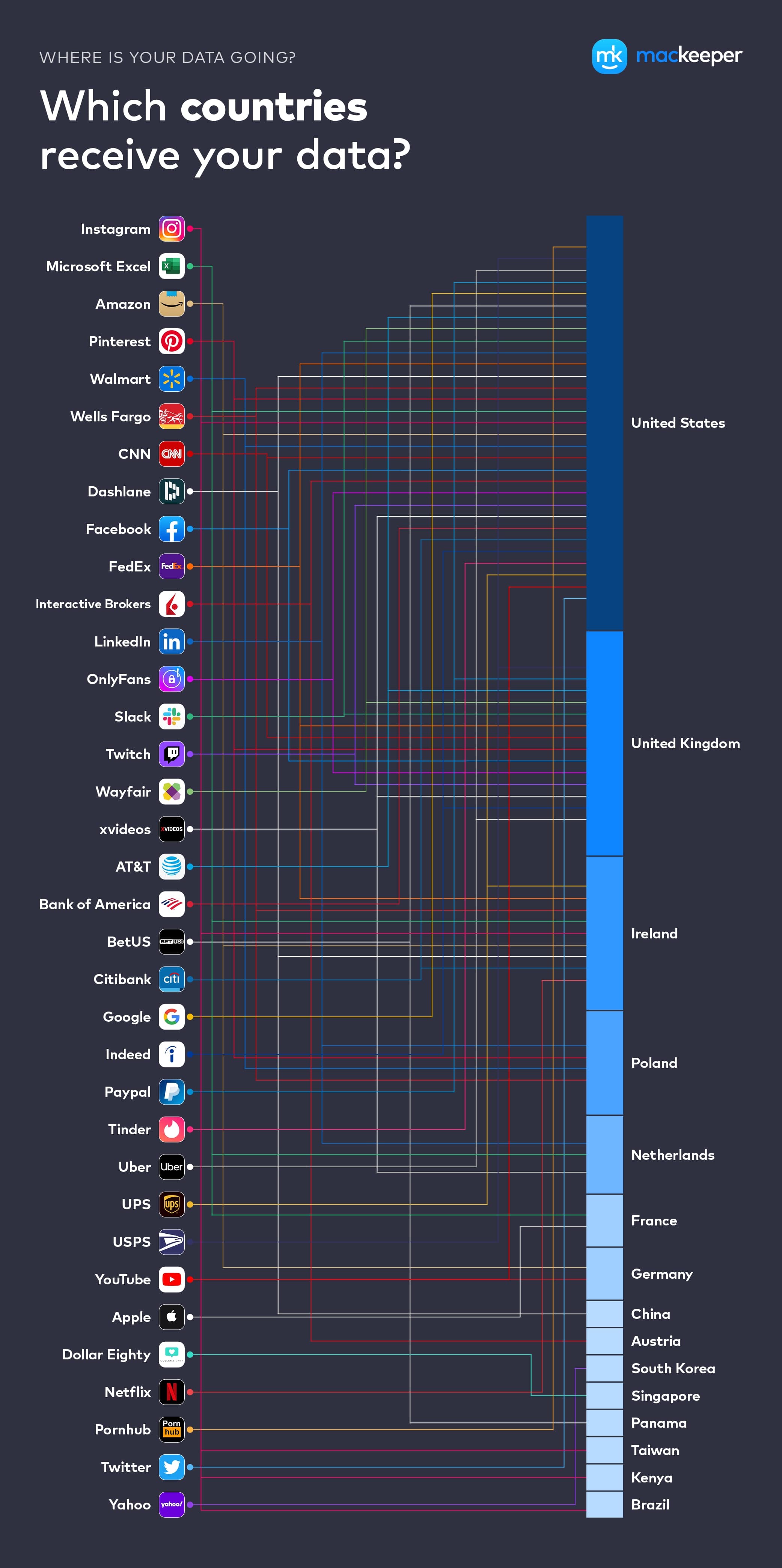
Your Instagram data gets sent to six different locations around the world, according to connection tracker LittleSnitch. From one remote endpoint, Instagram was sending data to:
Kansas, USA
Virginia, USA
Dublin, Ireland
Nairobi, Kenya
Rio Branco, Brazil
Taiwan
Ultimately, these will be the locations of server databases/storage where companies store user data securely. These multiple data points create more opportunities for cybercriminals to exploit and breach your information.
Instagram’s parent company, Facebook, isn’t far off in terms of data sharing.
Not only does it track 70.59% of your available data like your job history, hobbies and interests, but also passes it onto three locations: London, Manchester and Kansas.
The ramifications of this breach mean cybercriminals have access to information needed for security systems like banking logins, which require a two-step authentication process.
Kansas is the data capital of the world
Kansas is the data capital of the world, with 39 companies sending their information there. Some of these companies include:
Pornhub
Facebook
Twitter
Instagram
CNN
Walmart
Amazon
Bank of America
A note from our experts:
Data sharing is a common thing in the modern digital world. Popular companies send your data to different countries. Luckily, there is a way to keep your personal information safe and track its leakage. MacKeeeper’s ID Theft Guard keeps your payments, correspondence, passwords, etc safe. It alerts you in case of data breaches.
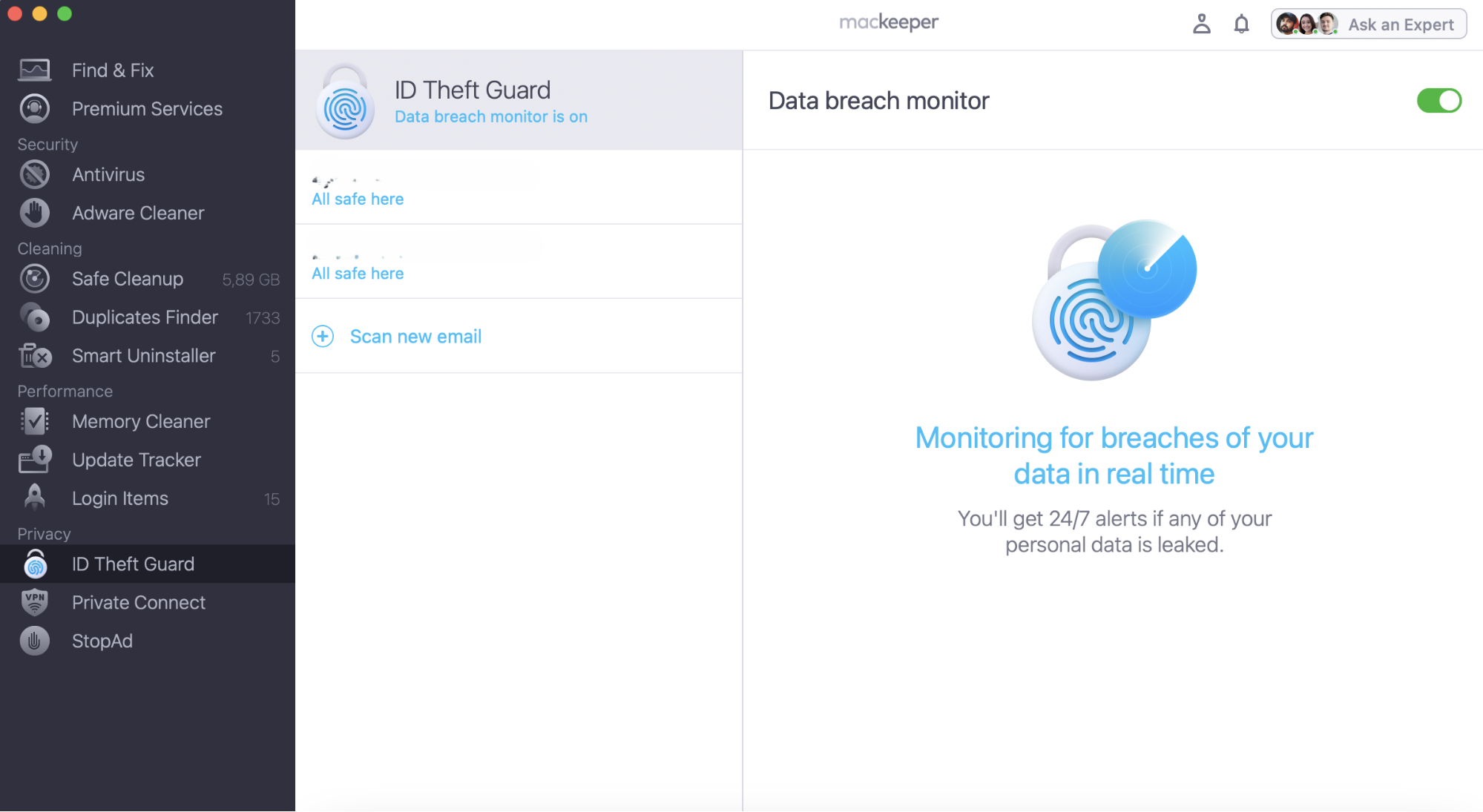
Select ID Theft Guard from the Privacy section on the left.
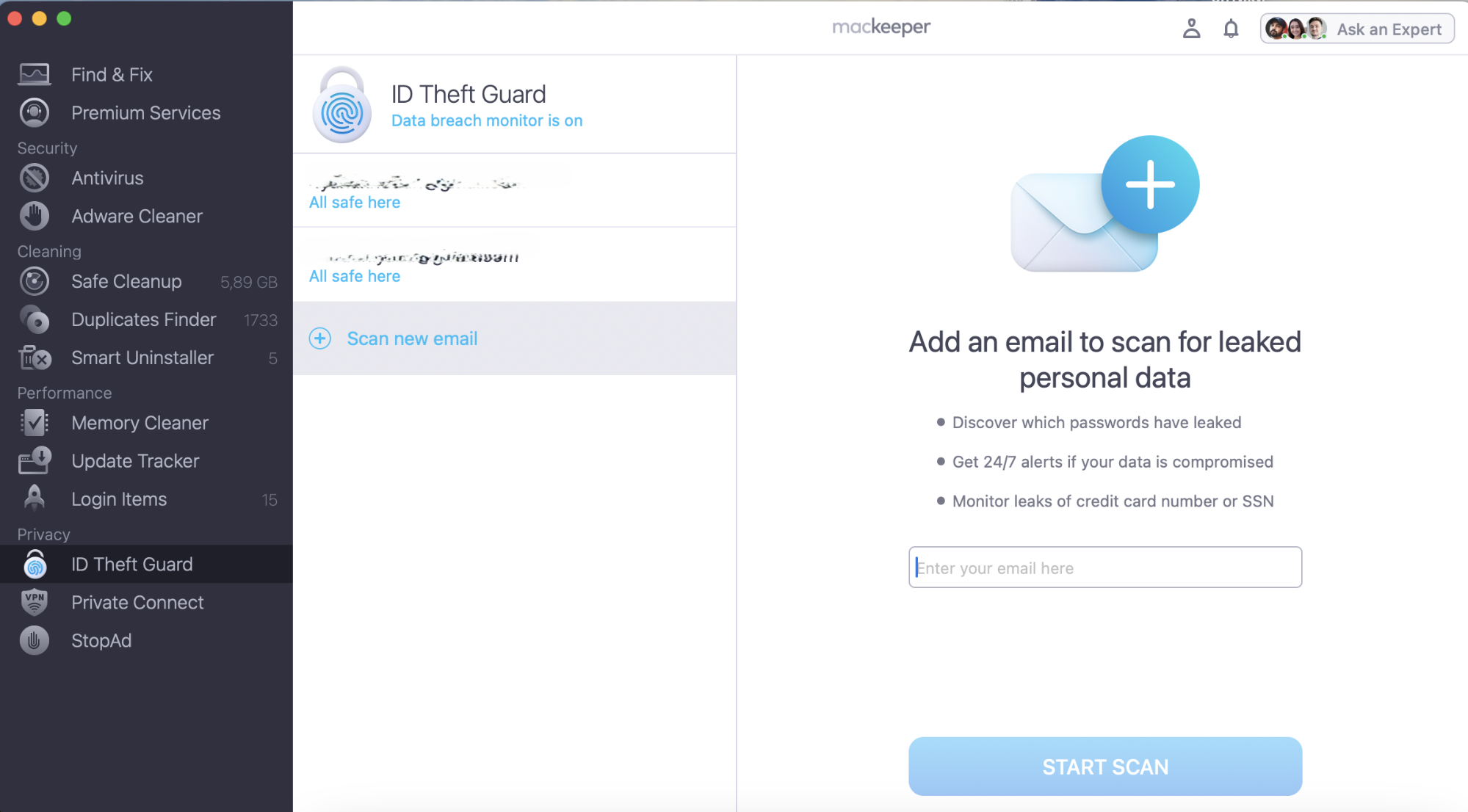
Click Scan new email and enter your email address.
Click Start Scan.
Step 1. MacKeeper > ID Theft Guard > Scan new emailStep 2. Enter your email > Start scan
So why does this all matter?
When your data gets sent to different countries across the world, they have different privacy laws to regulate how they handle data breaches and consumer information
Kansas state laws are classed as very weak when it comes to data privacy and cybersecurity. Research into state legislature shows it has a lack of any form of active legislation to protect consumer data. Despite Kansas being the data epicenter, the authorities don’t have a general privacy act in place and, without these laws, individuals don’t have as much control over their data.
On the other hand, California’s consumer data privacy law restricts the use of sensitive data - like someone’s sexual orientation, Social Security number or union membership - and this also makes location tracking less precise.
It’s groundbreaking for Californian residents because it allows consumers to sue companies if the privacy guidelines are violated. Consumers can demand to see all the information a company has saved on them, as well as a full list of all the third parties the data is shared with.
However, this is just one example of a good data privacy law. Once data gets sent around the world, it’s difficult to police it.
Search engines and browsers send your data to five different locations!
As well as specific sites themselves, the browser Google Chrome is one of the biggest undercover spies of them all.
It allows cookies to track the websites you visit so they can build a user profile on your likes, personality and income.
This data is then sent to the location stores in four countries around the world.
Search engines like Google and Yahoo send your data to data centers in these cities and countries:
Kansas, USA
California, USA
South Korea
Ukraine
Poland
So, what does this mean for you?
There are around 70,000 Google searches each second - about 5.4 billion a day.
That is a lot of data potentially stored in Kansas and California. And a lot of data that could potentially be hacked.
Your preferences, online searches, purchases and location data could all be revealed, which could lead to a whole host of problems like identity theft.
Your porn data is safer than your banking details
Banks have an immense amount of data on their clients through thousands, if not millions of individual pieces of information surrounding transactional histories. With this information, they can monitor spending patterns and personalize product offerings.
But, just how safe is your information with a bank?
Banks like Wells Fargo send your data to four locations around the world:
Kansas
North Carolina
Dublin
Poland
Whereas your porn data such as your interests, preferences and email address only gets sent to Kansas. Having your data available in multiple stores puts it at greater risk of being breached, meaning your porn details are safer than any data stored by banks you think you can trust.
Which websites are sending your data across the world?
Rank
Website
Type of Site
Number of locations data sent to
1
Instagram
Social media
6
2
Microsoft Excel
Programming
6
3
Amazon US
Shopping
5
4
Pinterest
Social media
4
5
Wells Fargo
Banking
4
6
Wallmart
Shopping
4
7
Facebook
Social media
3
8
Xvideos
Porn
3
9
CNN
News
3
10
FedEx
Postal
3
11
Twitch.tv
Streaming
3
12
Wayfair.com
Shopping
3
13
Onlyfans.com
Porn
3
14
Slack
Messaging
3
15
Dashlane (Skimresources)
Password manager
3
16
Interactive brokers
Financial
3
17
LinkedIn
Social media
3
18
Citibank
Banking
2
19
Paypal
Banking
2
20
USPS
Postal
2
21
Deliveroo
Food
2
22
Indeed
Housing
2
23
ATT
Phone
2
24
UPS
Postal
2
25
Tinder
Dating
2
26
Uber
Travel
2
27
Bank of America
Banking
2
28
BetUS
Betting
2
29
MyBookie
Betting
2
30
Google
Search engine
2
31
Youtube
Social media
2
32
BBC
News
2
33
Amazon UK
Shopping
2
34
Ladbrokes
Betting
1
35
Pornhub
Porn
1
36
Pirate Bay
Digital
1
37
123movie
Streaming
1
38
Netflix
Streaming
1
39
Twitter
Social media
1
40
Plentyoffish
Dating
1
41
eharmony
Dating
1
42
Doordash
Food
1
43
Dropbox
Cloud
1
44
Google Chrome
Browsing
1
45
Brand24.com
Software
1
46
Yahoo (yahoons.net)
Browsing
1
47
Yandex.ru
Internet
1
48
News33post.com
News
1
49
dollareighty.com
Social media
1
50
xbox.com
Gaming
1
51
Sekindo.com
Digital
1
52
Apple.com
Shopping
1
53
BMW Group
Shopping
1
54
American Airlines
Transport
0
55
XnXX
Porn
0
Websites should aim to have users' privacy as a priority and should aim to keep your web history private to you. With Mackeeper’s VPN, you can mask your real IP address, keep browsing preferences private and enjoy a safer internet experience. It also includes a tracker blocker app for Mac, which works with the Safari and Chrome web browsers.
Methodology
The Mackeeper team analyzed 57 websites from different sectors such as banking, social media and retail using LittleSnitch - a piece of software that tracks IP connections and remote endpoints to find out where those websites are interacting and sending data they receive from consumers. All data regarding the locations of data sent by certain websites is taken from the LittleSnitch analysis.
Additional research was taken from security.org regarding varying legislative measures against data privacy in the USA.
Information about time spent on Instagram was taken from a Vox study.
We respect your privacy and
use cookies
for the best site experience.
Privacy Preferences Center
We use cookies along with other tools to give you the best possible experience while using the
MacKeeper website. Cookies are small text files that help the website load faster. The cookies we
use don’t contain any type of personal data meaning they never store information such as your
location, email address, or IP address.
Help us improve how you interact with our website by accepting the use of cookies. You can change
your privacy settings whenever you like.
Manage consent
All cookies
These cookies are strictly necessary for enabling basic website functionality (including page
navigation, form submission, language detection, post commenting), downloading and purchasing
software. The website might malfunction without these cookies.